Pioneering -
Innovative -
Creative



QTSC9, Quang Trung Software City, Trung My Tay Ward, Ho Chi Minh City, Vietnam


OpenAI Ads: When Advertising Enters the AI Era
The way people search for information is changing. Instead of browsing through search results, users are increasingly turning to AI platforms to ask questions, compare options, and make decisions. As this behavior evolves, advertising is entering a new space: AI-powered conversations.
With OpenAI Ads now rolling out in Vietnam, businesses have a new opportunity to reach potential customers directly within the ChatGPT experience. So, what exactly are ChatGPT Ads, how do they work, and what could they mean for businesses? Let’s explore with Aegona.
1. What Are OpenAI Ads?
OpenAI Ads refers to the advertising offering that allows businesses to reach users within the ChatGPT experience.
Unlike traditional search advertising, where users typically enter keywords and browse a list of sponsored results, advertising on ChatGPT takes place within a conversational environment. Users may be asking questions, exploring solutions, comparing products, or looking for recommendations when a relevant advertisement appears.
This creates a different advertising context.
A user may not simply be searching for a product. They may already be thinking about a business problem and asking AI to help them evaluate possible solutions.
For example, a business owner might ask:
“What CRM software is suitable for a company with 50 sales representatives?”
In this type of situation, a relevant advertisement could potentially appear alongside the user's ChatGPT experience.
This shift is important because it moves advertising closer to the moment when users are actively exploring and evaluating their options.
2. How Does Advertising on ChatGPT Appear?
Ads in ChatGPT are designed to be clearly distinguishable from ChatGPT's answers.
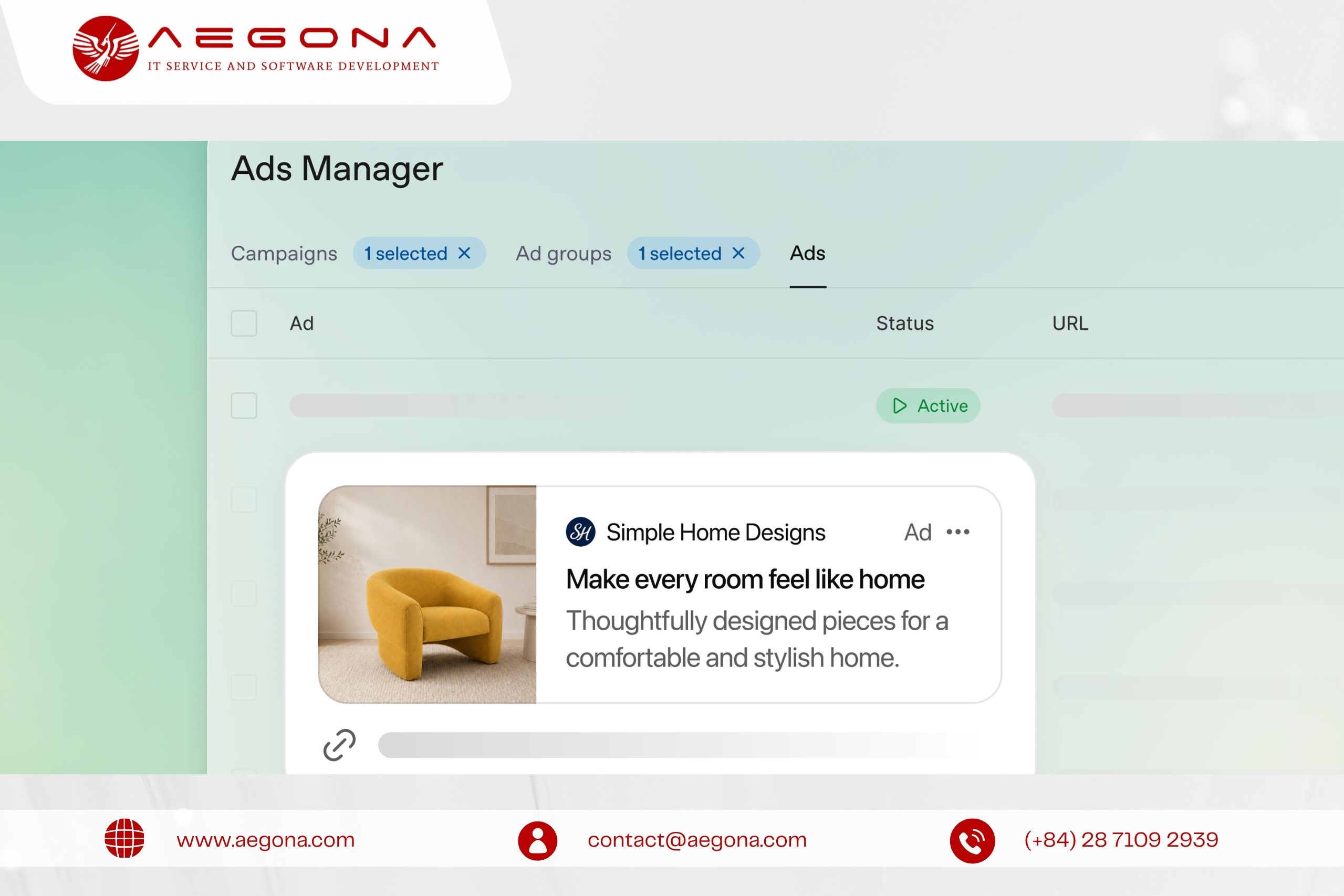
According to OpenAI, advertisements appear below the response and are visually separated and clearly labeled as sponsored content. The ad may include elements such as the advertiser's name, logo, headline, copy, landing page, and image.
This distinction is important because ChatGPT Ads do not influence the content of ChatGPT's answers.
In other words, an advertisement does not determine what ChatGPT says in response to a user's question. The advertising system and the answer-generation system operate separately.
For businesses, this means ChatGPT Ads should not be viewed as a way to influence organic AI answers. Instead, they represent a separate paid channel for reaching users within the AI environment.
>>> Readmore: AI Assistant Solution – Optimizing IT Services for Small And Medium Businesses
3. How Does OpenAI Ads Select Relevant Advertising?
One of the most interesting differences between traditional digital advertising and AI advertising is the role of context.
OpenAI says ad selection can take into account signals such as the current conversation context and user intent, as well as information related to the advertisement itself, including its landing page, title, and copy.
Depending on the user's settings and market, broader signals from their ChatGPT experience may also be considered.
This is different from thinking about advertising purely in terms of individual keywords.
Consider two searches:
- “CRM software”
- “What CRM should I use to manage a 50-person sales team?”
The second query contains much more information about the user's situation and intent.
An AI platform can understand the broader context of a conversation, which creates the potential for a different type of advertising experience, one that is closer to the user's actual decision-making process.
However, businesses should not interpret this as a guarantee that a specific keyword or conversation will trigger an advertisement. OpenAI notes that contextual signals are not exact-match keywords and do not guarantee ad delivery.
4. ChatGPT Ads Are Now Available in Vietnam
OpenAI has expanded its advertising program to Vietnam, alongside several other markets in Southeast Asia and Taiwan.
This marks an important development for businesses operating in Vietnam. Advertising on ChatGPT is no longer simply a concept being tested in other markets; it is becoming part of the broader digital advertising landscape.
Currently, ads are shown to users on eligible Free and Go plans, while paid plans such as Plus, Pro, Business, Enterprise, and Edu remain ad-free.
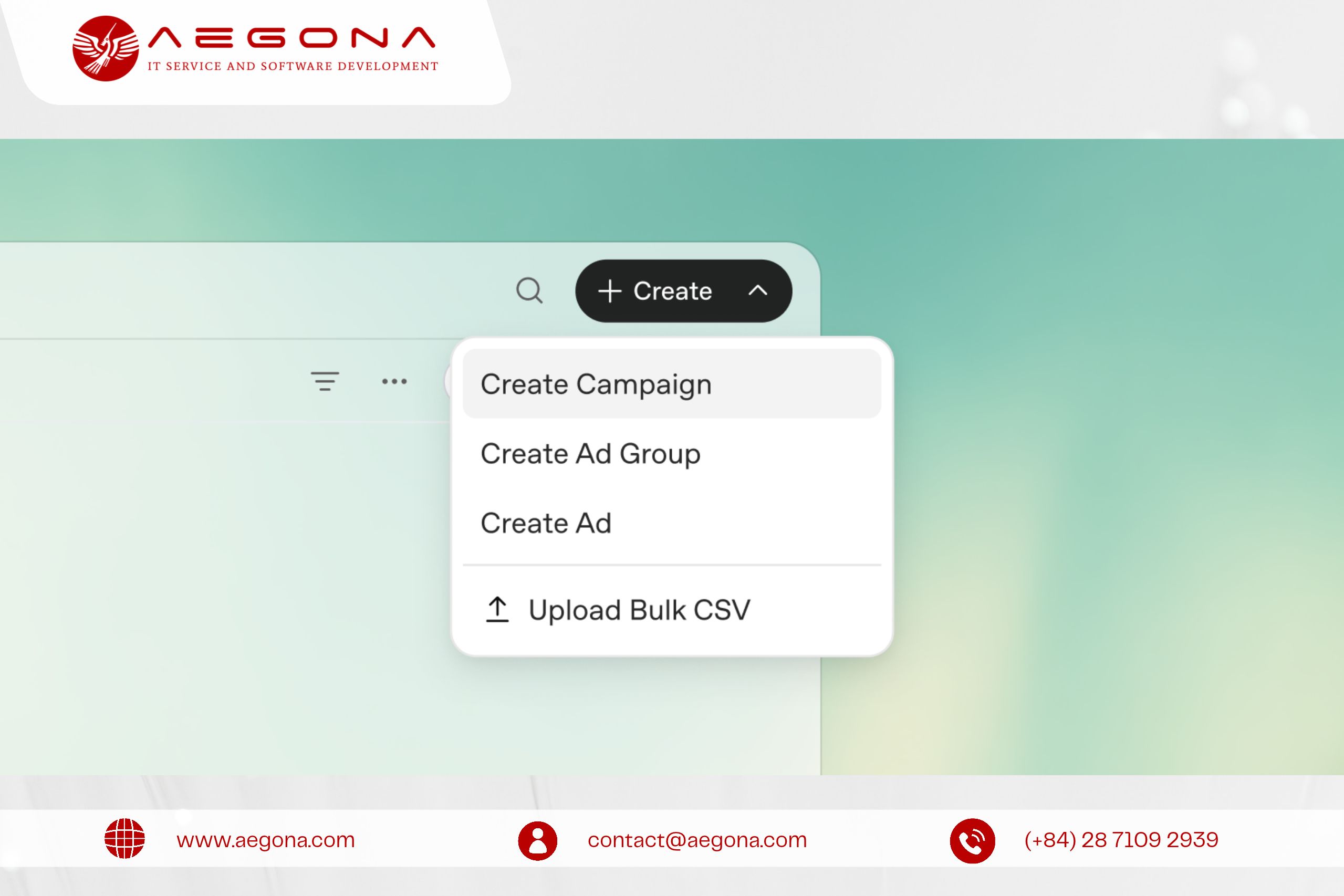
For businesses, access to this emerging channel depends on eligibility and availability through OpenAI's advertising ecosystem, including OpenAI Ads Manager for eligible advertisers.
The expansion also reflects a broader trend: AI platforms are becoming places where people do more than simply search for information.
Users are increasingly using AI to:
- Research products and services
- Compare different options
- Explore solutions to business problems
- Plan purchases
- Ask for recommendations
- Evaluate potential decisions
As these behaviors grow, the opportunity for businesses to reach customers within AI platforms is likely to become increasingly important.
>>> Read more: Custom End-to-End AI Agent Development Company For Enterprises
5. Is OpenAI Ads the New Google Ads?
It would be tempting to describe OpenAI Ads as “the new Google Ads.” However, the comparison is not quite that simple.
Google Search Ads are built around search queries and search results. Users typically enter keywords, receive a list of results, and interact with those results.
ChatGPT offers a different environment.
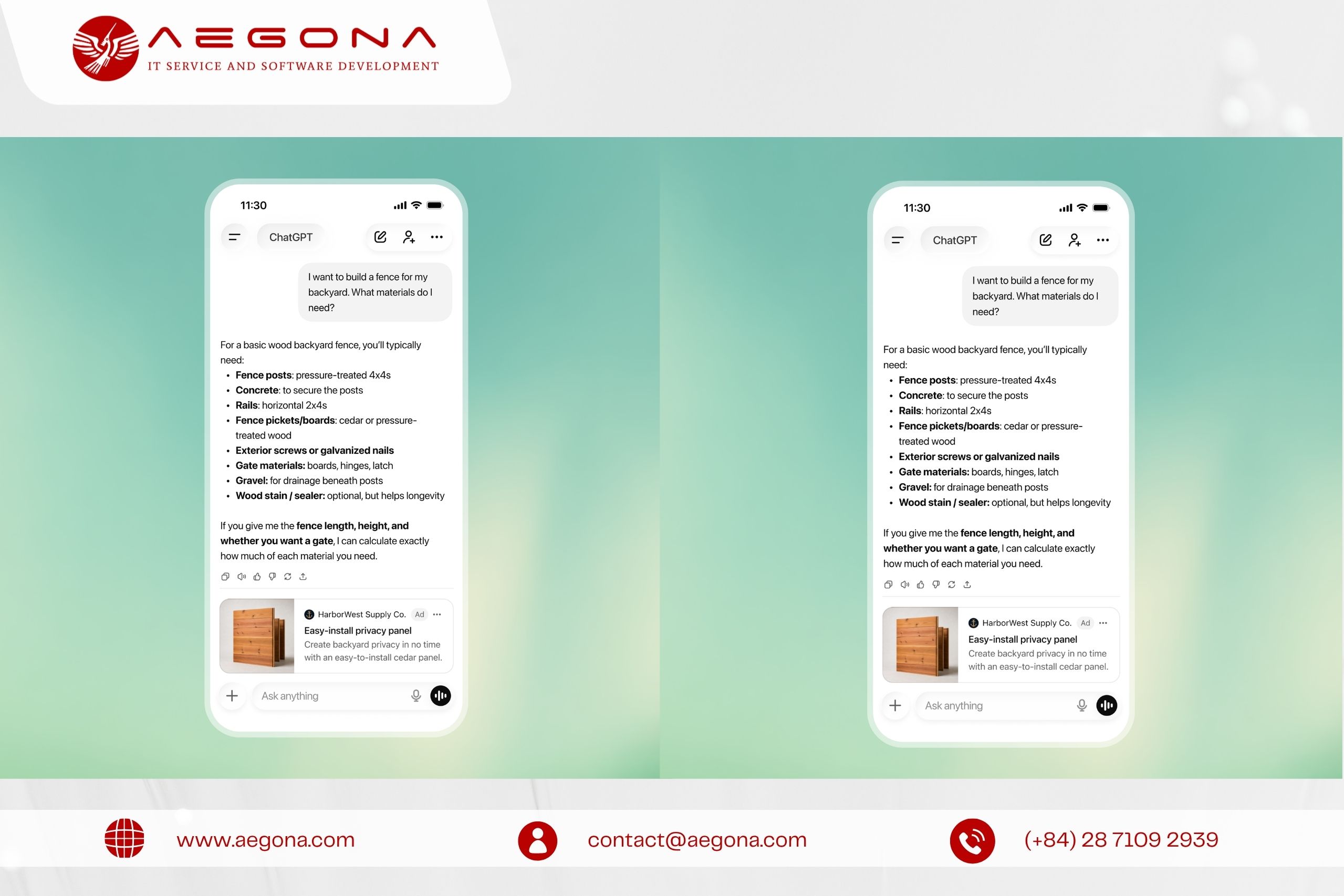
A conversation can involve multiple questions, changing requirements, comparisons, and follow-up discussions. Instead of simply searching for “CRM software,” for example, a user might explain their company size, budget, industry, current challenges, and requirements over several messages.
This makes AI platforms fundamentally different advertising environments.
Therefore, businesses should not think about OpenAI Ads as a direct replacement for Google Ads or other existing advertising channels.
Instead, it may become another layer of the digital marketing ecosystem, particularly as customers increasingly use AI to research and evaluate products and services.
6. What Does OpenAI Ads Mean for Marketing in the AI Era?
The rise of ChatGPT Ads is part of a much larger shift in digital marketing.
For years, businesses have focused on questions such as:
How can we rank higher on Google?
SEO remains important. Search engines are still major sources of traffic, discovery, and commercial intent.
But another question is becoming increasingly relevant:
How can our brand appear when customers are asking AI?
This is where strategies such as AEO (Answer Engine Optimization) and GEO (Generative Engine Optimization) are gaining attention.
These approaches focus on improving a brand's visibility across AI-generated answers, recommendations, and citations.
At the same time, paid advertising introduces another path.
AEO and GEO focus on earning organic visibility within AI-generated responses, while OpenAI Ads provides a paid opportunity to reach users within the ChatGPT experience.
These approaches should not necessarily be viewed as competitors.
They can become complementary parts of a broader AI-era marketing strategy.
>>> Read more: AI + ERP: The Trend Driving Fully Automated Business Operations
7. What Should Businesses Prepare for OpenAI Ads?
The arrival of OpenAI Ads does not mean businesses should immediately shift their entire advertising strategy to ChatGPT.
Instead, it is a signal to start paying attention to how customer behavior is changing.
Businesses should consider several areas.
1. Understand how customers use AI
Look beyond traditional search behavior.
What questions are customers asking AI? What problems are they trying to solve? What products or services are they comparing?
Understanding these questions can help businesses identify new opportunities for both organic and paid visibility.
2. Strengthen brand presence across AI ecosystems
Being visible on an AI platform is not simply about running advertisements.
Businesses also need credible websites, useful content, strong brand information, and a consistent digital presence that AI systems can understand and reference.
3. Think beyond keywords
Traditional advertising often starts with keyword research.
With AI, businesses need to think more broadly about intent, context, problems, and decision-making scenarios.
Instead of asking only:
“Which keyword should we target?”
Businesses may increasingly need to ask:
“What problem is our potential customer trying to solve?”
4. Combine paid and organic AI visibility
Paid advertising can provide a direct way to reach users, while AEO and GEO can support organic brand visibility within AI-generated answers.
A stronger AI-era strategy may therefore combine both approaches instead of relying on only one.
8. Explore AI Opportunities with Aegona
AI is changing the way businesses operate, communicate with customers, and approach digital growth. OpenAI Ads is only one part of this broader transformation.
At Aegona, we help businesses explore and implement practical AI solutions, from AI Agents and Automation to technology solutions tailored to specific business needs.
If your business is looking to understand how AI can be applied to marketing, customer engagement, or daily operations, contact Aegona to discuss your business needs and explore the right AI approach.
Contact us for today:
AEGONA LTD – IT Service & Software Development
[P] 028 7109 2939 (08:00 – 17:00, Mon – Fri)
[M] 0914 518 869 | 0869 731 689
[W] www.aegona.vn | www.aegona.com
[Zalo] https://bit.ly/41UeXrx
[HQ-Lab1] Orbital Building (QTSC Building 9), Quang Trung Software City, Ho Chi Minh City, Vietnam
[Lab 2] QTSC 1 Building, Quang Trung Software City, Ho Chi Minh City, Vietnam
related post
Shopify website design and development tailored to your business, with custom themes, integrations, features, and maintenance.
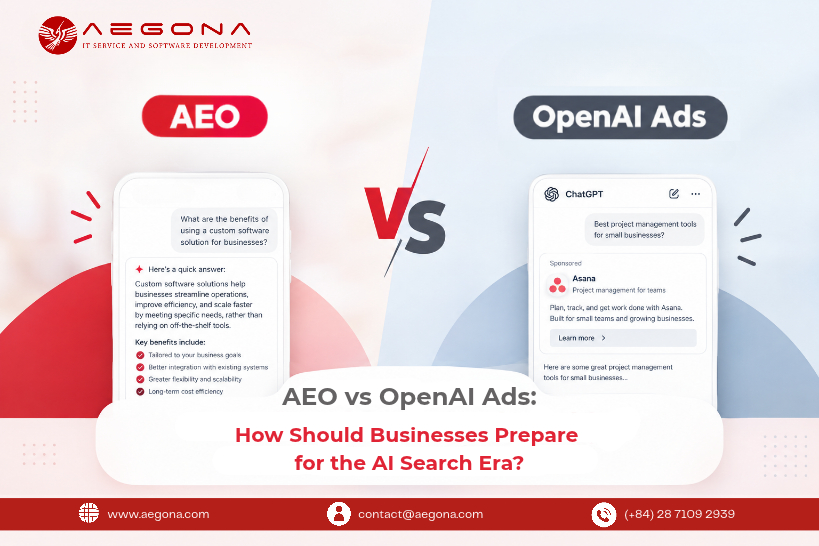
AEO vs OpenAI Ads: discover the difference between AI Search optimization and ChatGPT advertising, and what businesses should consider in the AI era.
Custom PoC/MVP development services by Aegona to validate software ideas, reduce development risks, and build scalable solutions for your business.
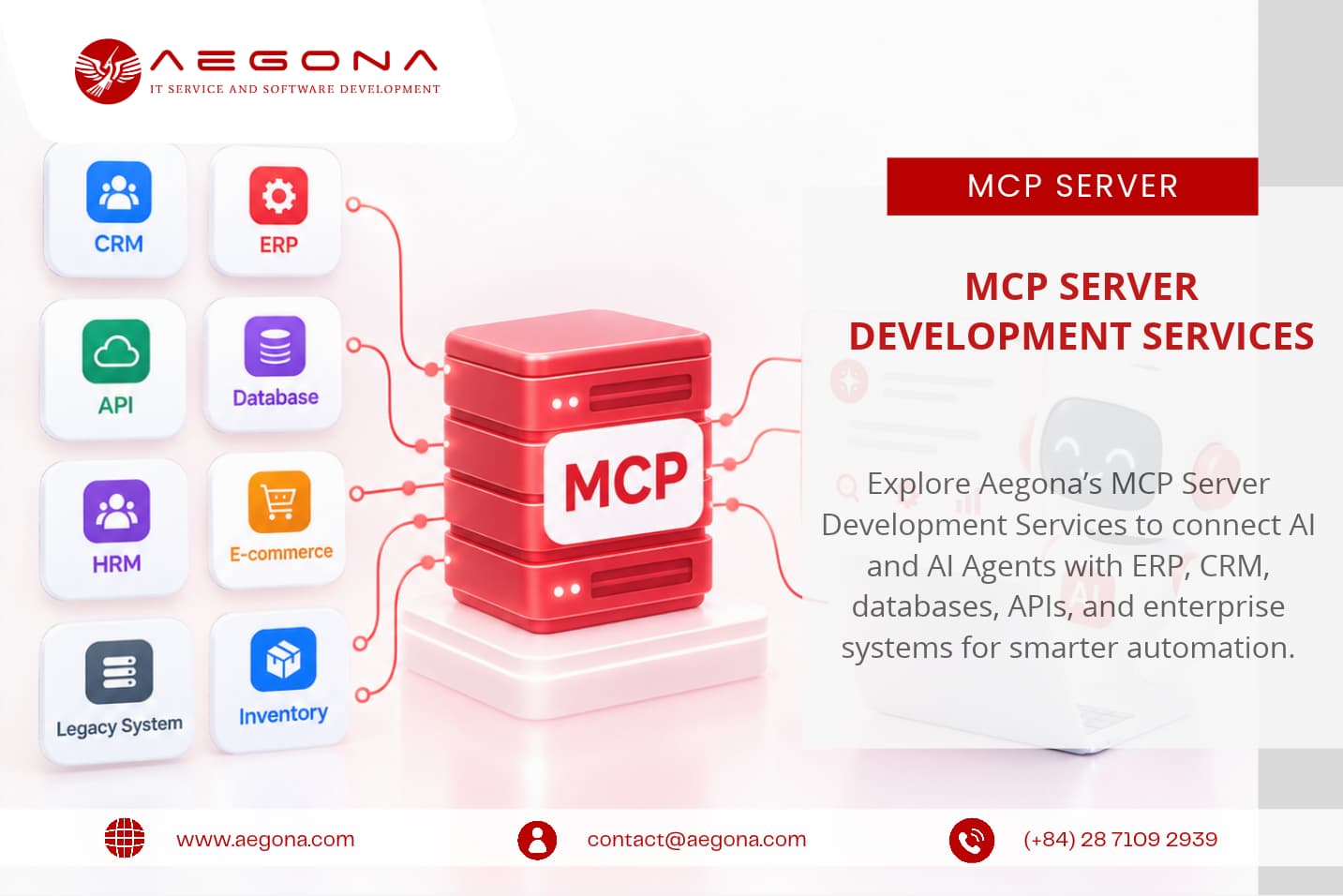
Explore Aegona’s MCP Server Development Services to connect AI and AI Agents with ERP, CRM, databases, APIs, and enterprise systems for smarter automation.
Scale your development team with Aegona’s Staff Augmentation Services. Hire skilled Java, PHP, Fullstack Developers in Vietnam for your projects.
AEGONA provides Odoo ODC services with flexible models, including Dedicated Odoo Developer, Dedicated Odoo Team, and Full Odoo ODC.
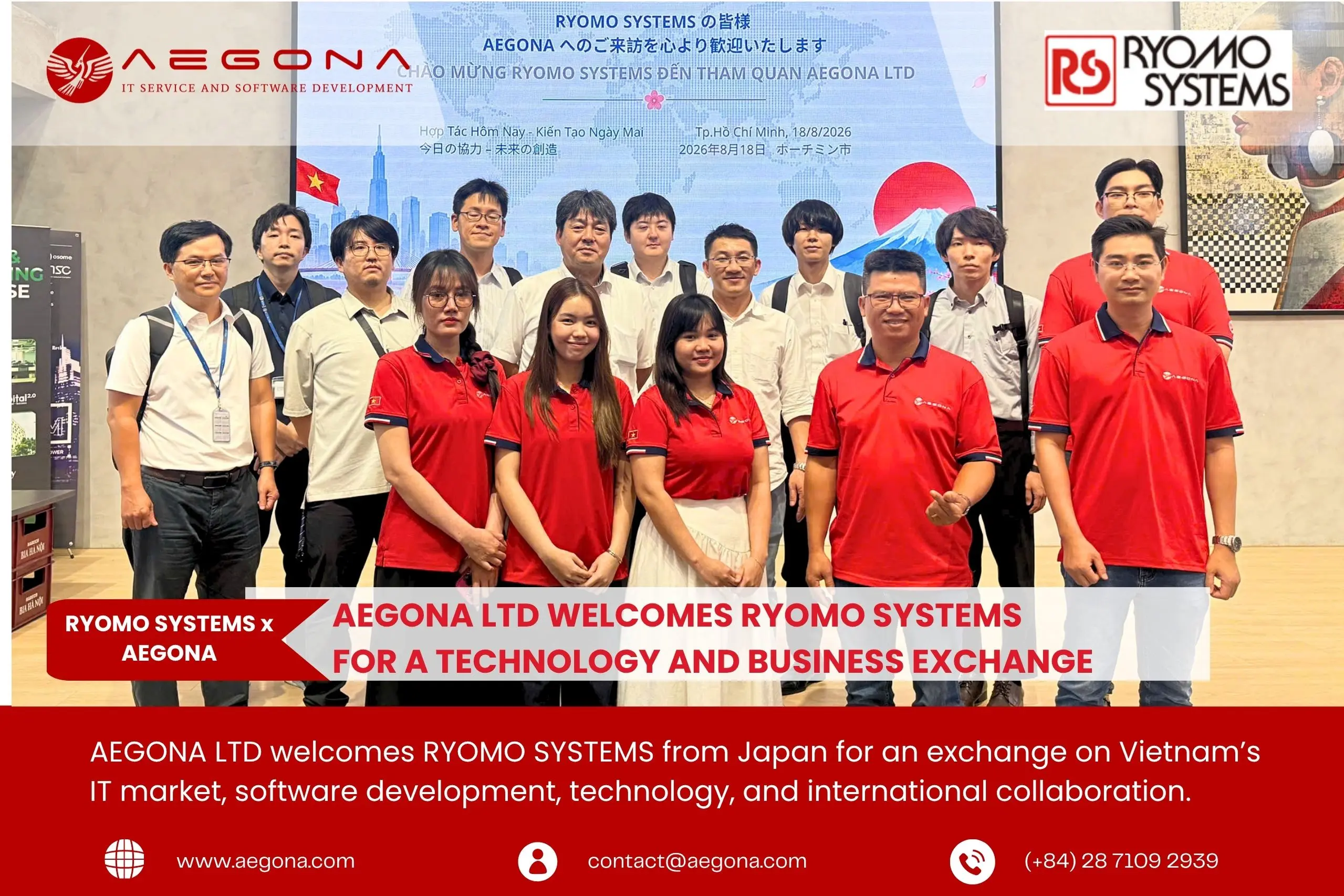
AEGONA welcomes RYOMO SYSTEMS from Japan for an exchange on Vietnam’s IT market, software development, technology, and international collaboration.
AI-powered legacy application modernization services in Vietnam. Aegona helps businesses refactor, migrate, and modernize legacy systems faster.

Hire experienced Java Backend Developers at Aegona to build scalable, secure, and high-performance Enterprise Backend systems with flexible outsourcing models.
Outsource C/C++ Developers in Vietnam with Aegona to access skilled talent, scale your team flexibly, accelerate development, and optimize costs.
Discover the top 5 software outsourcing companies in Vietnam (2026). Compare leading providers, their services, expertise, and find the right technology partner for your software development project.
Aegona provides custom End-to-End AI Agent development services, delivering secure, scalable AI solutions that automate business processes and integrate seamlessly with your existing systems.
Aegona provides experienced Angular Developers in Vietnam to build scalable web applications with flexible hiring models and offshore development solutions.