Pioneering -
Innovative -
Creative



QTSC9, Quang Trung Software City, Trung My Tay Ward, Ho Chi Minh City, Vietnam


AEO vs OpenAI Ads: How Should Businesses Prepare for the AI Search Era?
For years, businesses have been familiar with one key question: How can a website appear on Google when customers search for something?
SEO emerged to address that challenge. But the way people search for information is changing. Instead of entering a few keywords and browsing through multiple search results, users are increasingly asking AI tools direct questions, expecting them to synthesize information, compare options, and provide recommendations.
This raises a new question: When customers ask AI about a product, service, or a particular industry, where will your brand appear?
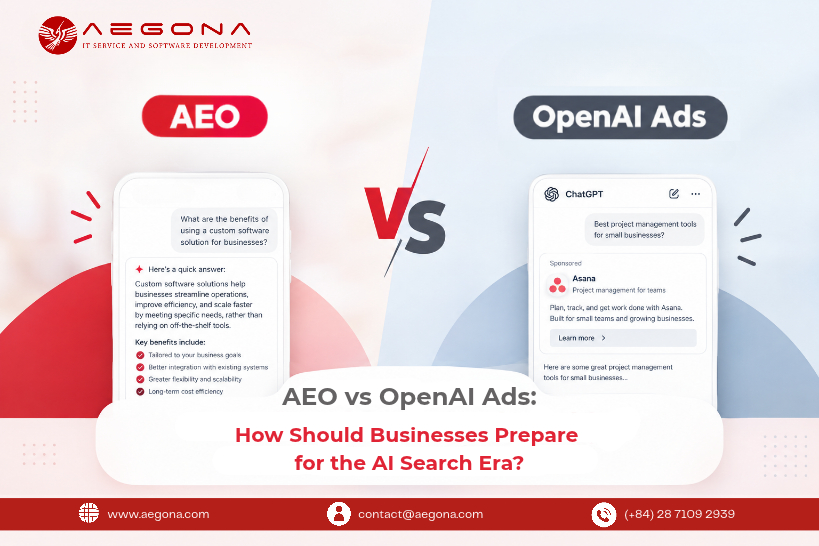
Two approaches are gaining increasing attention: AEO (Answer Engine Optimization) and OpenAI Ads. One focuses on the possibility of being mentioned organically by AI, while the other provides a paid visibility channel. Let’s explore AEO vs OpenAI Ads in more detail with Aegona in the following article.
1. What Is AEO?
Answer Engine Optimization (AEO) is the practice of optimizing content so that it can be naturally understood, selected, and referenced by AI-powered answer engines.
Unlike traditional SEO, which primarily focuses on ranking web pages in search engine results, AEO focuses on how information is presented and interpreted by AI systems.
The goal is not simply to rank for a keyword. Instead, businesses need to create content that provides clear, reliable, and useful answers to the questions their target audience is asking.
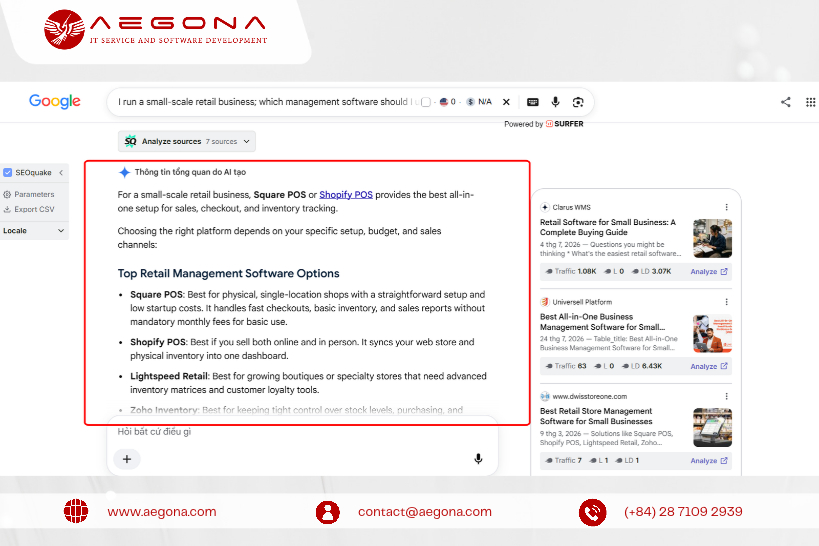
For example, when a user asks an AI assistant to compare software providers, explain a technology, or recommend a solution, the system may generate an answer using information from multiple sources.
A strong AEO strategy increases the possibility that a business, product, service, or piece of content will be considered relevant within that answer.
How AEO Works
AEO typically involves:
- Creating clear and well-structured content
- Answering specific questions and search intents
- Providing accurate and trustworthy information
- Building topical authority around relevant subjects
- Structuring content so AI systems can understand key information easily
- Maintaining consistent and useful information across digital channels
In other words, AEO is about building organic visibility within AI-generated answers.
>>> Read more: AI Outsourcing – Custom AI Development Company in Vietnam
2. What Are OpenAI Ads?
OpenAI Ads, also referred to as ChatGPT Ads, represent a different approach.
Instead of optimizing content to be organically referenced by AI, businesses can use paid advertising to reach users within ChatGPT.
OpenAI describes its advertising model as a way for advertisers to reach people while they explore options, compare choices, and make decisions. Ads are presented separately from ChatGPT's responses and are clearly labeled as sponsored content.
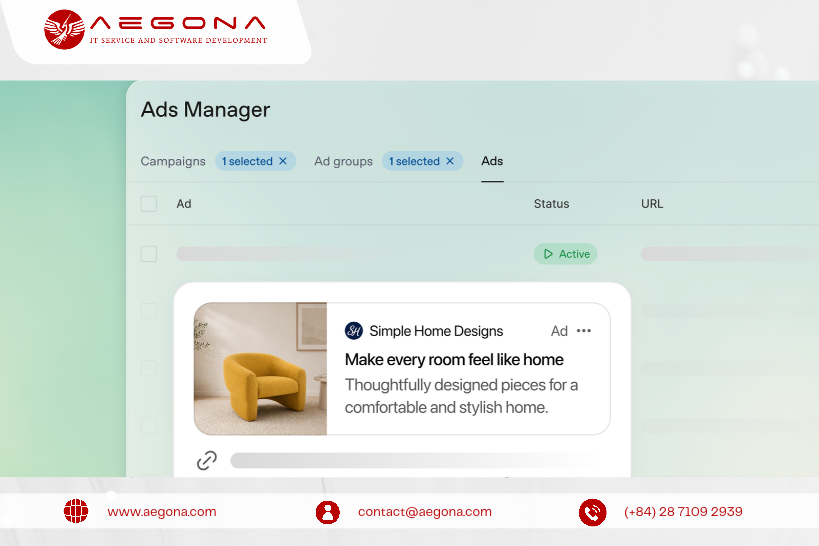
This creates a paid visibility channel within an AI-powered environment.
OpenAI has also introduced tools for advertisers, including Ads Manager, CPC bidding, and expanded measurement capabilities, as its advertising platform develops.
The key distinction is simple:
AEO earns visibility through content and relevance. OpenAI Ads buy visibility through advertising.
>>> Readmore: AI Assistant Solution – Optimizing IT Services for Small And Medium Businesses
3. AEO vs OpenAI Ads: What Is the Difference?
The differences between AEO vs OpenAI Ads become clearer when looking at how each approach generates visibility.
Factor | AEO | OpenAI Ads |
Approach | Organic optimization | Paid advertising |
Main objective | Increase visibility in AI-generated answers | Reach users through sponsored placements |
Visibility mechanism | Relevance, content quality, authority | Paid placement and advertising signals |
Cost model | Content and optimization investment | Advertising budget |
Content requirement | High-quality, structured, useful content | Ad creative and campaign assets |
Long-term value | Can build sustainable content visibility | Depends on ongoing advertising spend |
User experience | Information may be referenced naturally by AI | Advertisement is clearly labeled |
Relationship with SEO | Extends traditional SEO into AI Search | Adds a paid channel alongside organic strategies |
Neither approach is simply a replacement for the other.
They address different parts of the AI visibility journey.
4. Why AEO and OpenAI Ads Do Not Replace Each Other
The discussion around AEO vs OpenAI Ads can sometimes make the two approaches appear competitive. In practice, they can serve different business objectives.
AEO is focused on the organic side of AI visibility.
Businesses invest in content, expertise, structured information, and digital authority so that AI systems have useful information to understand and potentially reference.
OpenAI Ads, on the other hand, provide a paid channel for reaching users at relevant moments.
This is similar to the relationship between organic search and paid search. One does not necessarily eliminate the need for the other.
A business may build long-term organic visibility through content while using paid campaigns to reach specific audiences or support particular business objectives.
>>> Read more: Custom End-to-End AI Agent Development Company For Enterprises
5. A New Marketing Question: How Does AI Understand Your Brand?
The rise of AI Search changes the role of content. Previously, businesses often optimized content primarily around keywords and search rankings. Today, content also needs to communicate clearly with AI systems.
This does not mean abandoning SEO. Instead, businesses need to expand their search strategy from SEO to broader AI visibility.
A practical approach may include:
1. Continue Building Strong SEO Foundations
Technical SEO, relevant keywords, useful content, internal linking, website structure, and authority remain important.
AEO should complement these foundations rather than replace them.
2. Create Content Around Real User Questions
Instead of producing content only because a keyword has search volume, businesses can also consider the questions customers actually ask.
These questions can become:
- Educational articles
- Comparison pages
- Product explanations
- FAQs
- Industry insights
- Use cases
- Guides and practical resources
The objective is to make the company's expertise easier to understand and reference.
3. Build Clear Topical Authority
AI systems need context to understand what a business knows and what it offers.
Developing a consistent content ecosystem around core topics can help communicate that expertise more clearly.
For example, a software company offering AI solutions may build content around AI agents, workflow automation, enterprise AI, RAG, AI assistants, and system integration rather than publishing disconnected articles about unrelated trends.
4. Think Beyond Organic Visibility
AEO is only one part of the broader AI marketing landscape.
Paid advertising, brand presence, owned content, third-party references, product information, and customer-facing digital experiences can all contribute to how a business is discovered and understood.
This is where the conversation around AEO vs OpenAI Ads becomes more strategic.
The question is not necessarily which one to choose.
The more important question is:
What role should each channel play in your overall AI visibility strategy?
6. What Should Businesses Do Next?
The AI search landscape is still evolving. Businesses should therefore avoid treating AEO or AI advertising as a one-time marketing tactic.
Instead, consider building an AI-ready digital presence around three areas:
- Content: Create accurate, structured, useful content that answers real customer questions.
- Visibility: Monitor how your brand, products, and services appear across AI-powered search experiences.
- Technology: Identify opportunities to use AI not only for marketing, but also for customer service, internal knowledge, and business processes.
This broader approach allows businesses to move from simply being visible in AI to actually using AI as part of their business operations.
>>> Read more: AI + ERP: The Trend Driving Fully Automated Business Operations
7. Aegona – Building AI Solutions Around Real Business Problems
AI visibility is only one part of the transformation businesses are facing.
As AI becomes more integrated into search, customer service, internal operations, and business workflows, companies also need technology solutions that can work with their existing systems and processes.
At Aegona, we approach AI from the business problem first, then select the technology that fits.
Our AI Agent & Automation solutions include:
- Custom AI Agents for specific business requirements
- Chatbot & AI Assistant for customer support and automated responses
- AI Workflow & Agent Systems to connect tasks, tools, and business processes
- Private LLM + RAG for working with internal knowledge and documents
- Integration with ERP, CRM, email, and enterprise data
From identifying the right use case and developing a PoC to deployment and ongoing support, Aegona helps businesses turn AI opportunities into practical solutions.
Explore Aegona's AI Agent & Automation solutions to discover how AI can be applied to your specific business needs.
Contact us for today:
AEGONA LTD – IT Service & Software Development
[P] 028 7109 2939 (08:00 – 17:00, Mon – Fri)
[M] 0914 518 869 | 0869 731 689
[W] www.aegona.vn | www.aegona.com
[Zalo] https://bit.ly/41UeXrx
[HQ-Lab1] Orbital Building (QTSC Building 9), Quang Trung Software City, Ho Chi Minh City, Vietnam
[Lab 2] QTSC 1 Building, Quang Trung Software City, Ho Chi Minh City, Vietnam
related post
AEO vs OpenAI Ads: discover the difference between AI Search optimization and ChatGPT advertising, and what businesses should consider in the AI era.
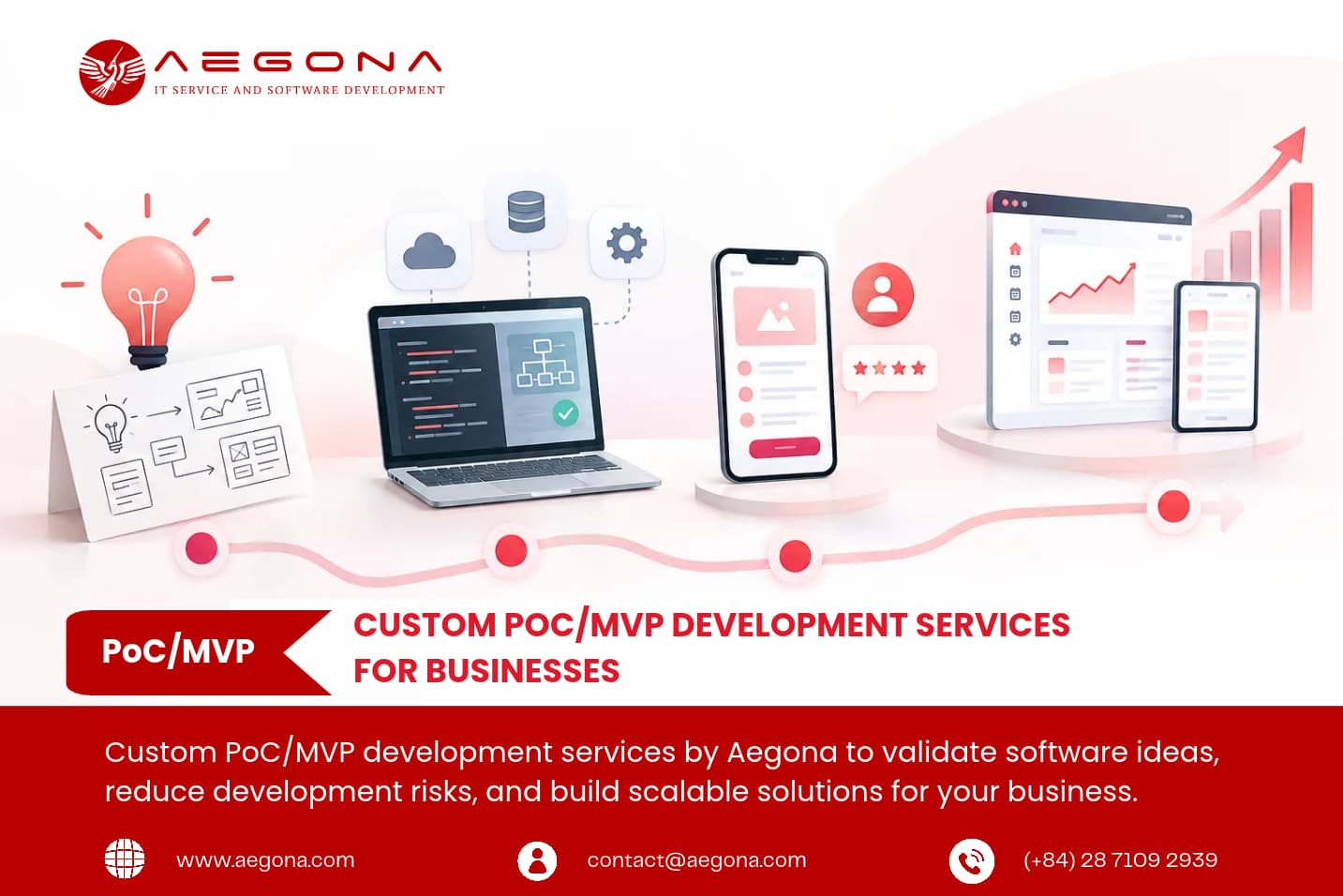
Custom PoC/MVP development services by Aegona to validate software ideas, reduce development risks, and build scalable solutions for your business.
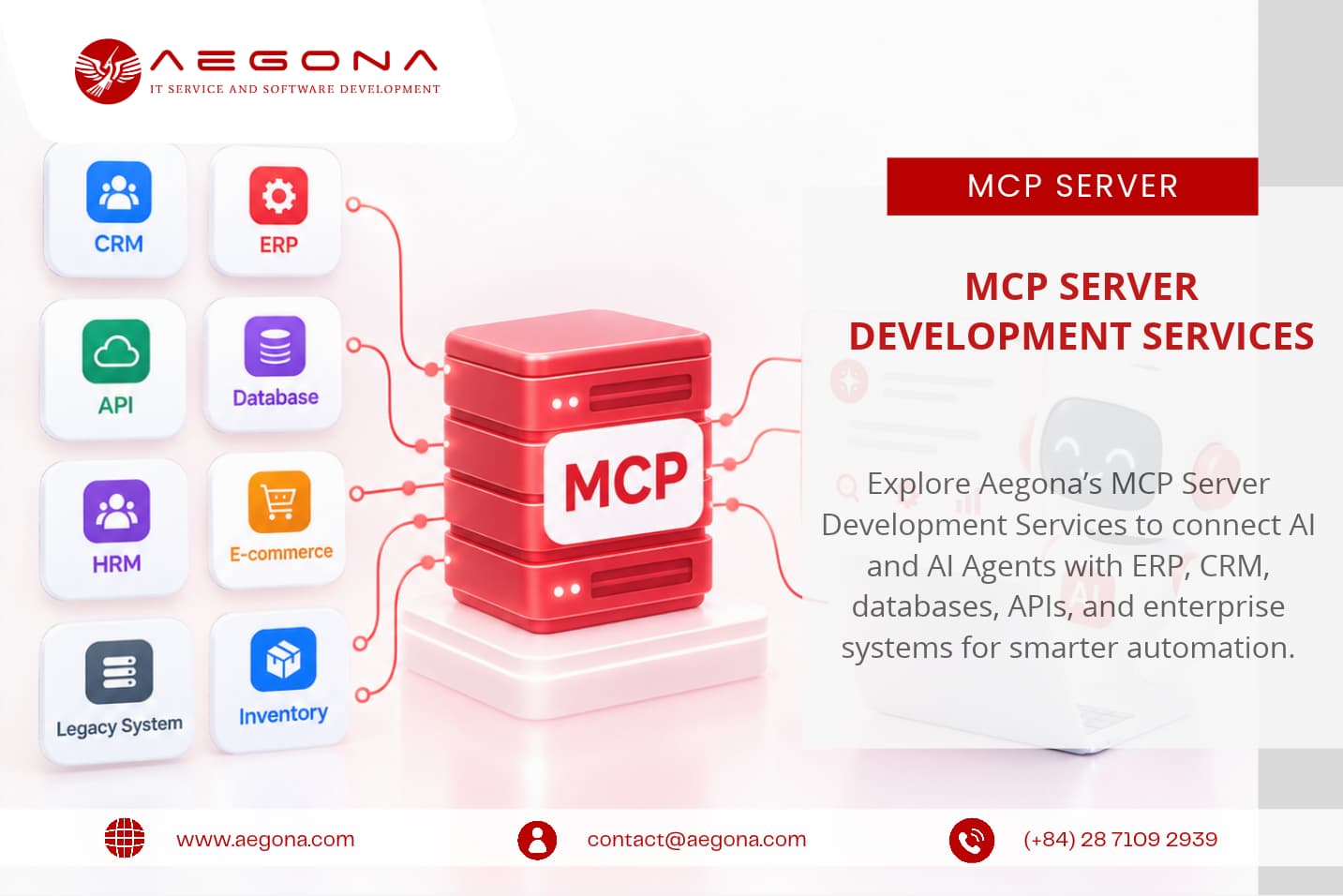
Explore Aegona’s MCP Server Development Services to connect AI and AI Agents with ERP, CRM, databases, APIs, and enterprise systems for smarter automation.
Scale your development team with Aegona’s Staff Augmentation Services. Hire skilled Java, PHP, Fullstack Developers in Vietnam for your projects.
AEGONA provides Odoo ODC services with flexible models, including Dedicated Odoo Developer, Dedicated Odoo Team, and Full Odoo ODC.
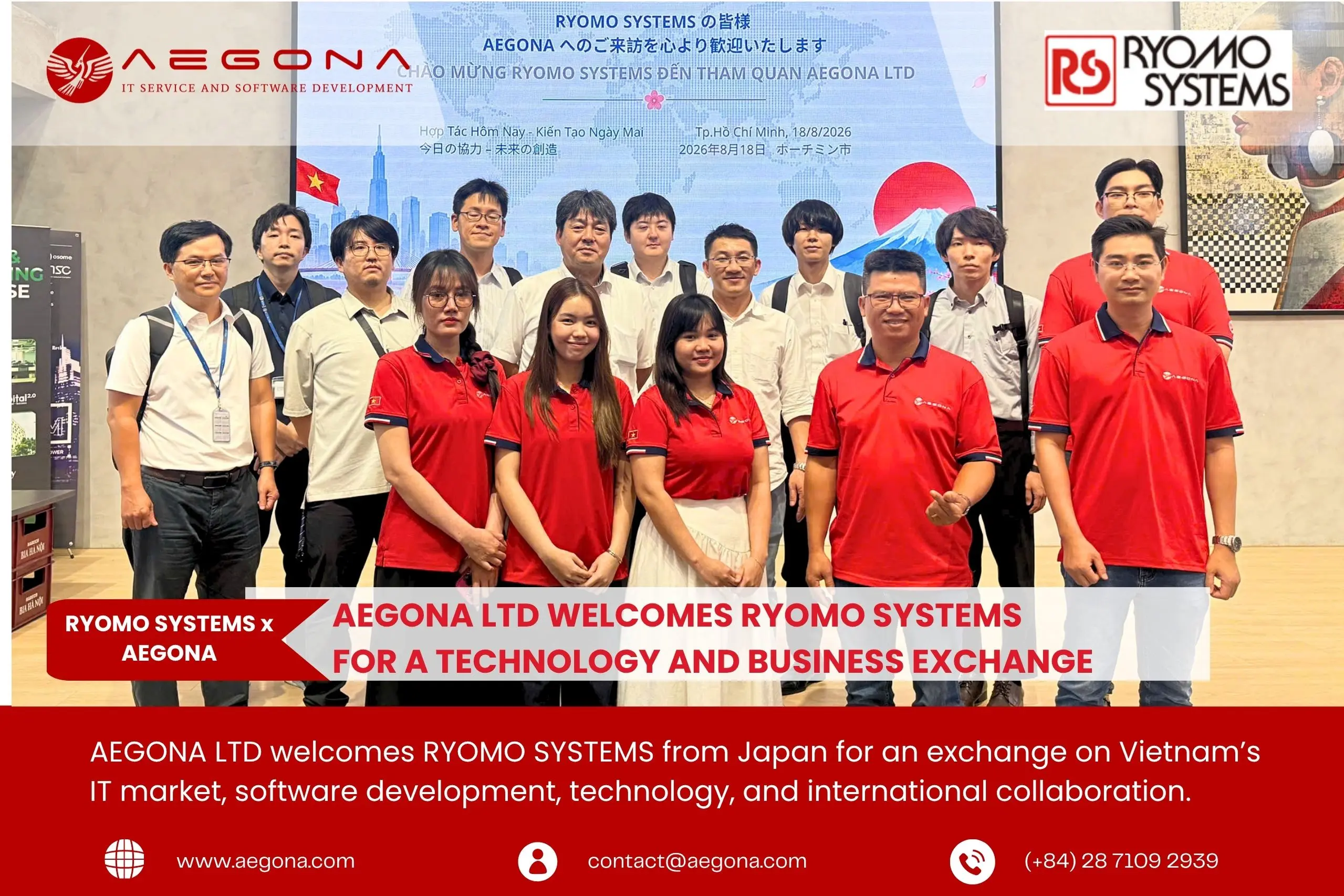
AEGONA welcomes RYOMO SYSTEMS from Japan for an exchange on Vietnam’s IT market, software development, technology, and international collaboration.
AI-powered legacy application modernization services in Vietnam. Aegona helps businesses refactor, migrate, and modernize legacy systems faster.
Hire experienced Java Backend Developers at Aegona to build scalable, secure, and high-performance Enterprise Backend systems with flexible outsourcing models.
Outsource C/C++ Developers in Vietnam with Aegona to access skilled talent, scale your team flexibly, accelerate development, and optimize costs.
Discover the top 5 software outsourcing companies in Vietnam (2026). Compare leading providers, their services, expertise, and find the right technology partner for your software development project.
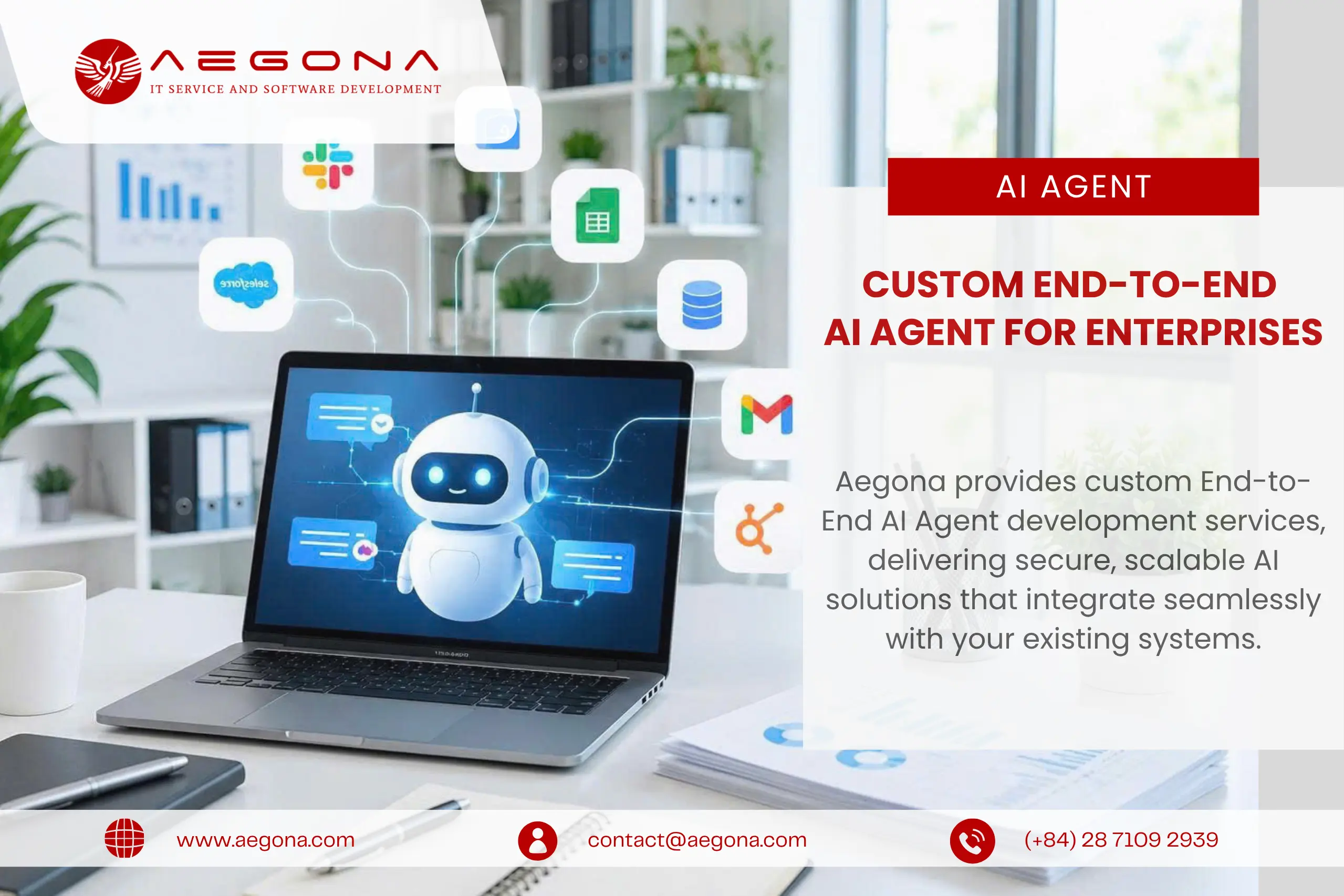
Aegona provides custom End-to-End AI Agent development services, delivering secure, scalable AI solutions that automate business processes and integrate seamlessly with your existing systems.
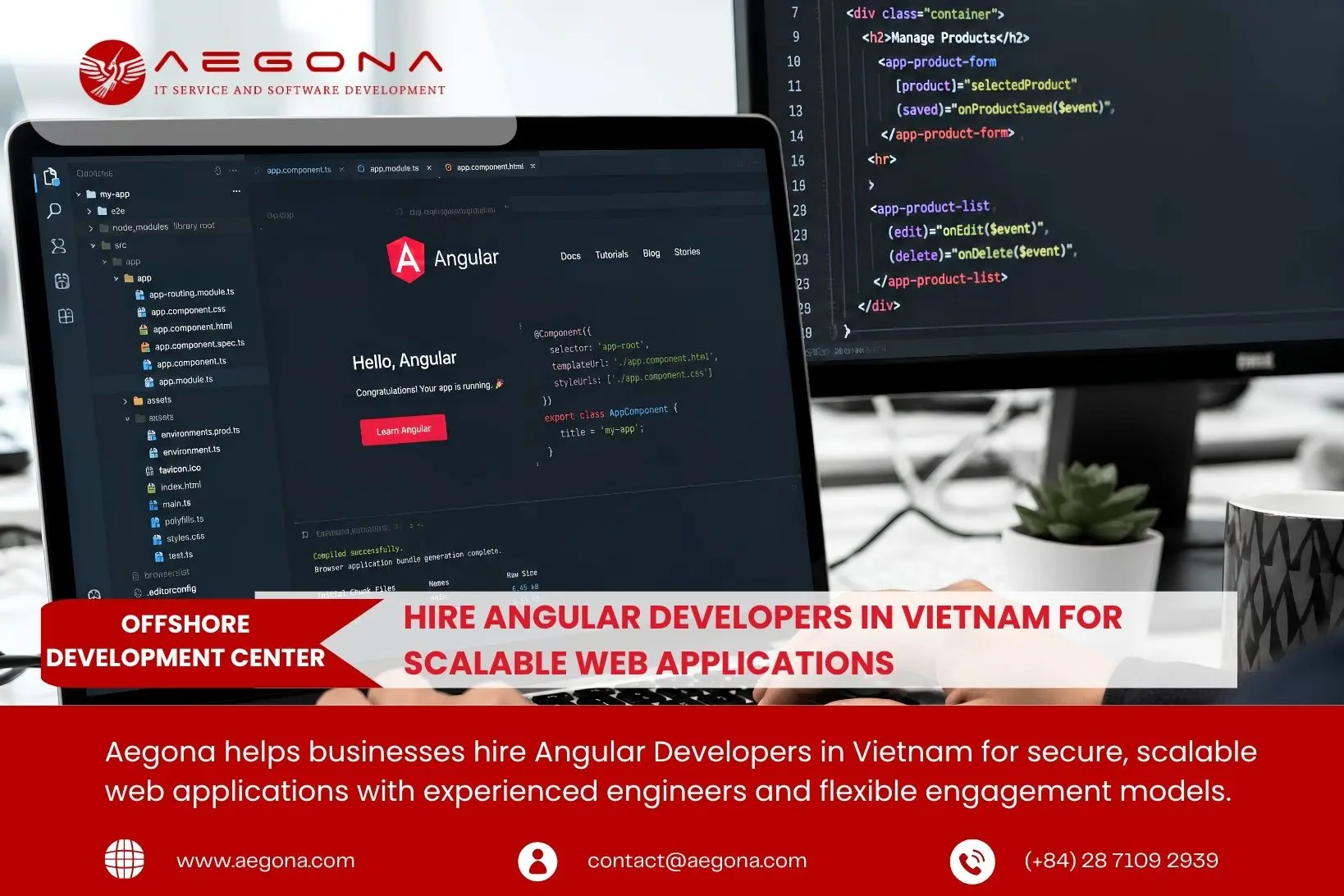
Aegona provides experienced Angular Developers in Vietnam to build scalable web applications with flexible hiring models and offshore development solutions.
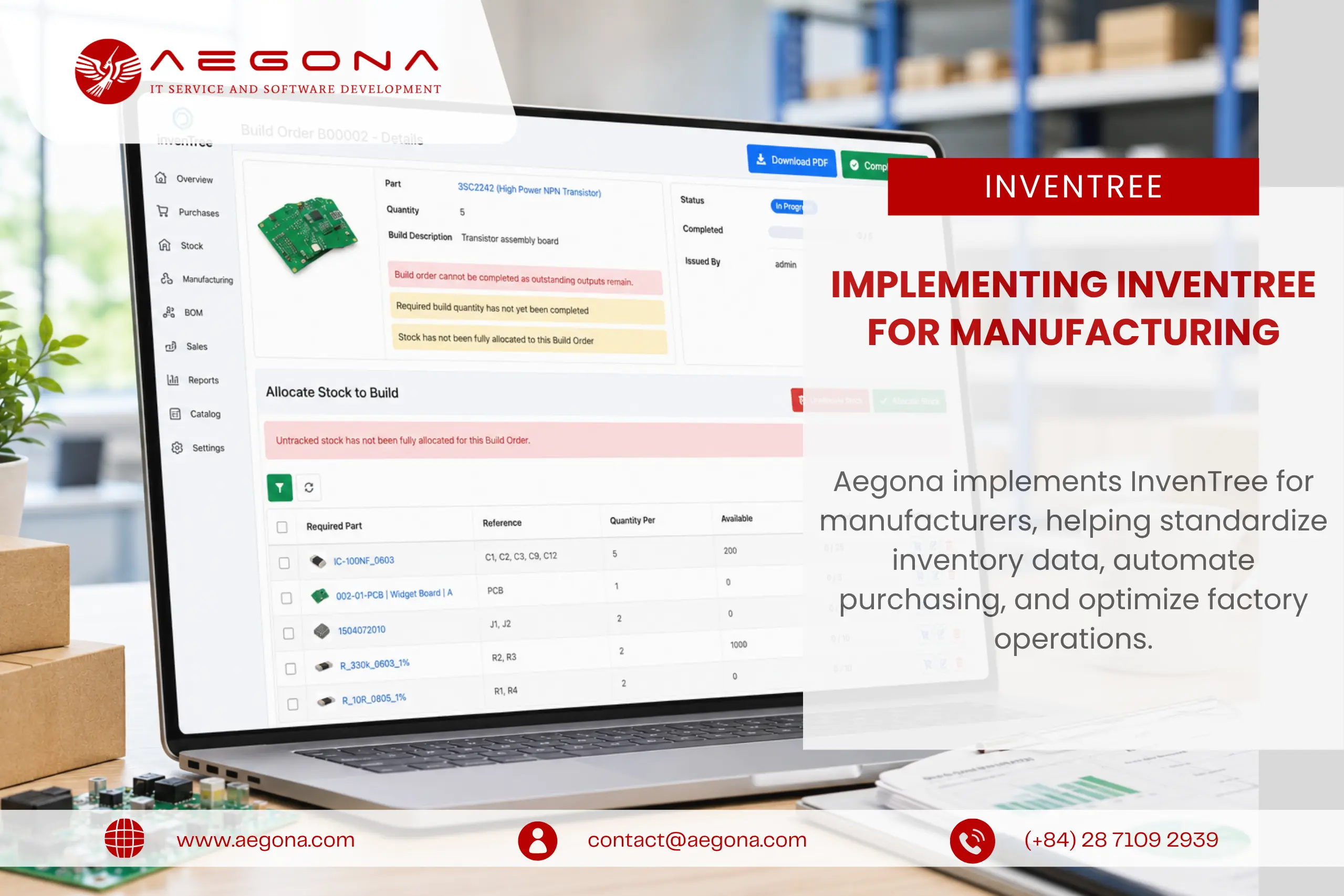
Aegona provides custom InvenTree implementation services to help manufacturers optimize inventory, purchasing, BOM, and production management with seamless ERP integration.